What Should a Lash Extension Tray Actually Cost?
Tags: pricing, supply chain, cost per set, wholesale
The Short Answer
A single tray of professional-grade lash extensions — classic or volume, any curl, any diameter — should cost between $6 and $15 depending on where you buy and how much you commit to upfront. If you're paying more than $15 per tray for standard PBT fiber lashes, you're overpaying. If you're paying less than $5, question the fiber quality and curl retention.
The longer answer depends on how the supply chain works and what you're actually paying for at each price point.
Where Tray Pricing Comes From
Every lash tray on the market starts at a manufacturer — almost always in China or Korea. The base manufacturing cost for a 12-row tray of PBT fiber lashes is roughly $2–4, depending on the curl complexity, fiber grade, and order volume.
From there, the price you pay depends on how many hands touch that tray before it reaches your station:
Direct from manufacturer: $3–6/tray. Requires bulk orders (usually 500+ trays minimum), long lead times (4–8 weeks), and you handle customs, shipping, and quality control yourself. Realistic only for established brands or co-ops.
Domestic supplier with own inventory: $6–12/tray. The supplier buys in bulk from a consistent manufacturer, holds stock domestically, and ships to you within days. You pay a markup for their warehousing, quality control, and fast fulfillment.
Marketplace resellers and dropshippers: $12–25/tray. These sellers buy from the same manufacturers (or from domestic suppliers) and add their own margin. You're paying for their marketing, not their supply chain.
Premium branded lines: $15–30/tray. Same PBT fiber, different packaging. The premium is brand positioning, not material quality. Some justify it with better QC or unique curl profiles — many don't.
What Actually Affects Quality
Price is a poor proxy for quality in this industry. Here's what actually matters:
Fiber grade. All professional lash extensions are PBT (polybutylene terephthalate) — the same synthetic fiber whether it's marketed as "mink," "silk," or "cashmere." The grade of PBT determines curl memory, flexibility, and how the lash holds its shape after heat exposure. Higher-grade PBT costs more to source but the difference at retail is $1–2/tray, not $10.
Heat-bonding vs. glue-bonding. Heat-bonded lashes hold their curl shape longer and shed less from the strip. Glue-bonded lashes are cheaper to produce but can lose curl memory faster, especially in humid climates. This is a manufacturing process choice, not a price tier.
Strip consistency. Easy-peel strips that release lashes cleanly save you time during application. Poorly bonded strips tear, leave residue, or release multiple lashes at once. This is quality control at the factory level.
Curl consistency across the tray. Every lash on a row should match. Inconsistent curls within a single tray mean the manufacturer isn't sorting properly — and that shows up in your finished sets.
The Math on Your Cost Per Set
A full classic set uses roughly 80–120 individual lash extensions. A volume set uses 300–500+ (depending on fan size). A standard 12-row tray contains approximately 12 rows of 15–20 lashes each, giving you roughly 180–240 lashes per tray.
At $8/tray (InnerBeauty Pro Access pricing):
- Classic full set: roughly half a tray = ~$4 in product cost
- Volume full set: roughly 1.5–2 trays = ~$12–16 in product cost
At $15/tray (typical branded supplier):
- Classic full set: ~$7.50 in product cost
- Volume full set: ~$22–30 in product cost
If you're doing 4–6 sets per day, that $7/tray difference adds up to $150–300/month in pure margin. Over a year, switching from a $15 supplier to an $8 supplier puts $1,800–3,600 back in your pocket — same quality fiber, same curls, same results on the lash bed.
Red Flags in Tray Pricing
Tiered pricing that requires volume commitments. "Buy 50 trays to unlock $9 pricing" means you're financing their inventory with your cash. A fair supplier gives you their best price on tray one.
Annual membership fees. If you're paying $200/year for access to "wholesale" pricing, add that cost back into your per-tray math. A $200 fee spread across 100 trays is $2/tray — suddenly that "wholesale" price isn't wholesale.
Pricing that changes with the season. Consistent pricing means the supplier has a stable relationship with their manufacturer. Fluctuating prices mean they're buying opportunistically, which also means inconsistent product.
No individual tray purchasing. If you can't buy one tray to test, the supplier knows their product doesn't sell itself.
What We Charge and Why
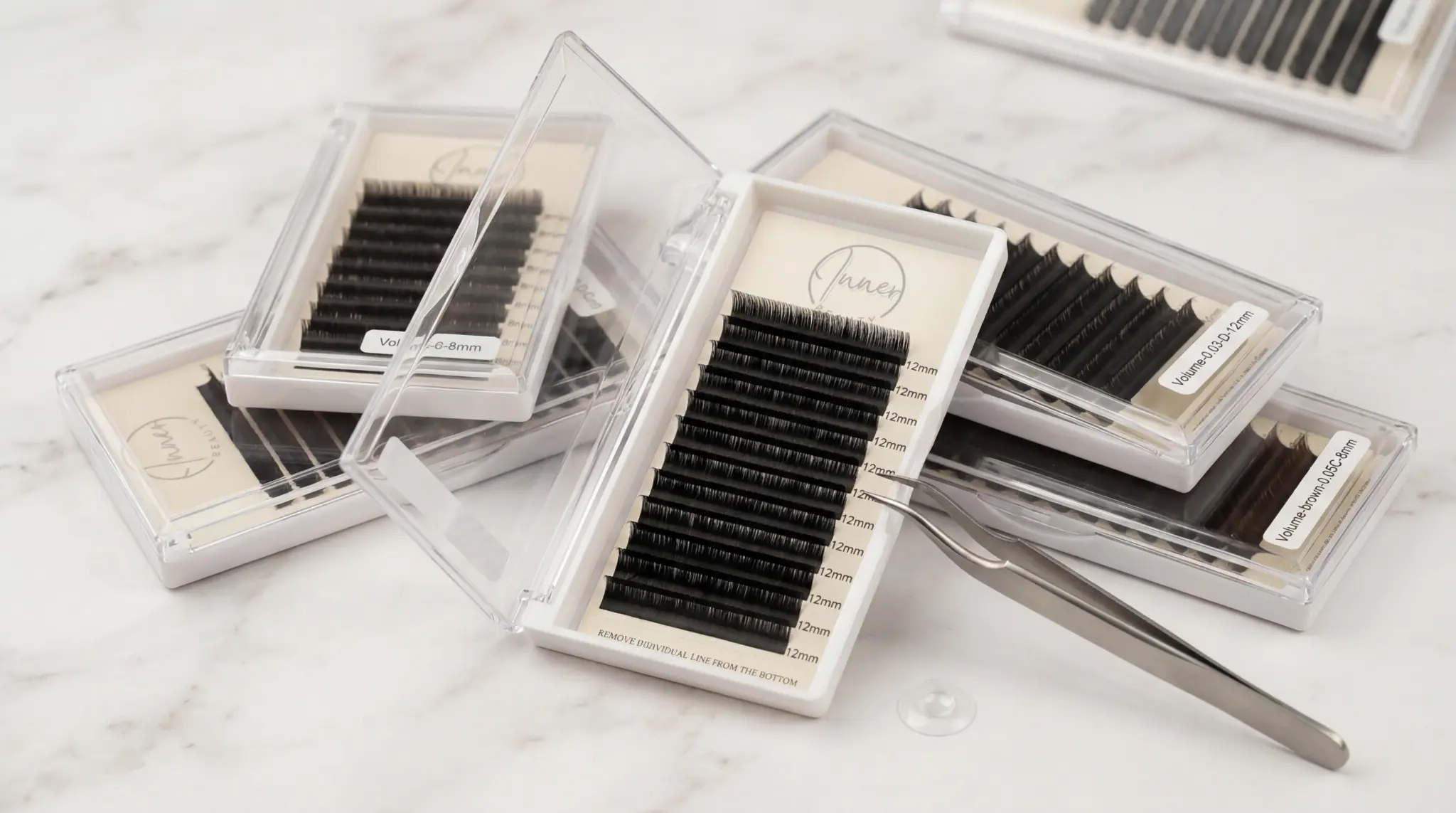
InnerBeauty trays are $12 retail, $8 with Pro Access. Every curl, every diameter, every length — same price. No minimums, no annual fee, no tier to maintain.
We can price at $8 because our lashes are manufactured for InnerBeauty by a production source we've worked with for over a decade. We hold inventory domestically in Everett, WA and ship ourselves. There's no middleman margin between the factory and your door.
Pro Access is free to join — apply here with your license and you're approved same-day. Your first tray ships free (just $5 shipping). After that, free shipping kicks in at $75+.
Browse the full catalog — 236 SKUs across classic and volume, every curl from J to D, every diameter from 0.03 to 0.20mm, lengths 7–16mm.