C Curl vs D Curl: How to Choose for Each Client
Tags: curls, c curl, d curl, lash mapping, technique
The Real Difference Between C and D
C curl and D curl are the two most-used curls in professional lash extensions — and the most commonly misunderstood. The difference isn't just "more dramatic" vs "less dramatic." It's about the angle of the curl relative to the natural lash, and how that angle interacts with your client's eye shape, lid space, and natural lash growth direction.
C curl has a moderate upward curve — roughly 30–40 degrees from the base. It follows the natural curvature of most lashes and creates a lifted, open-eye look without appearing overly styled. It's the workhorse curl for a reason.
D curl has a more dramatic curve — roughly 50–60 degrees. The tip points more directly upward, creating visible lift and the appearance of more lid space. It reads as "done" from across a room.
But here's what most curl comparison posts miss: the right choice depends on your client's natural lash growth angle, not just how dramatic they want their set to look.
Natural Lash Growth Angle Matters More Than Preference
Every client's natural lashes grow at a different angle relative to the lid. Some grow straight out (parallel to the ground), some grow slightly downward, and some already have a natural upward tilt.
Straight or slightly downward growth: A D curl on these lashes creates a sharp angle at the bond point. The extension curves up dramatically from a base that points forward or down. This looks lifted and open — but it also puts more torque on the bond, which can affect retention if the diameter is too heavy.
Naturally upward growth: These clients already have lift. A D curl on top of natural lift can look over-curled — the tips point almost straight up instead of fanning outward. C curl often gives these clients the "D curl look" because the natural angle does half the work.
The practical test: Have your client look straight ahead. If their natural lashes disappear behind the upper lid, they have downward growth and D curl will create visible lift. If you can already see their natural lash tips clearly, C curl will likely give them the drama they're asking for without over-curling.
When to Use C Curl
C curl is your default for a reason. It works on the widest range of eye shapes and natural lash types:
- Clients who want "natural but better" — C curl enhances without announcing itself
- Almond and round eyes — the moderate curve follows the natural eye shape
- Clients with naturally upward-growing lashes — C gives them visible curl without over-lifting
- Inner corners — C curl sits flatter against the lid and avoids poking
- Retention-sensitive clients — the gentler curve puts less stress on the bond point
In a mixed set, C curl typically covers 60–70% of the eye, with D curl reserved for the center or outer corner depending on the mapping style.
When to Use D Curl
D curl earns its place when you need visible lift or when the client's natural lash angle works against a softer curl:
- Hooded eyes — D curl pushes the tips above the hood, making the set visible when the eye is open
- Downward-growing natural lashes — D compensates for the growth angle and creates the lift that C can't achieve on these lashes
- Clients who want their set visible in photos — D curl reads from a distance and in front-facing shots
- Center of the eye in doll-eye mapping — D curl at the center with C on the sides creates the round, open effect
- Shorter lengths where you still need visible curl — a 10mm D curl shows more curve than a 10mm C curl
Mixing C and D in One Set
Most experienced artists don't choose one curl for an entire set. A mixed approach gives you more control over the final shape:
Cat eye: C curl inner to mid-eye, D curl outer third. The transition creates a sweep without the inner corner lifting too aggressively.
Doll eye: C curl inner and outer, D curl center. The center lift opens the eye vertically.
Natural with lift: C curl everywhere, D curl on the center 5–6 lashes only. Subtle but effective — the client sees "my lashes but better" with just enough lift to notice.
The transition between C and D should happen gradually. Jumping from C to D on adjacent lashes creates a visible break in the curl line. Place 2–3 transitional lashes where you blend the curls.
C and D in Our Catalog
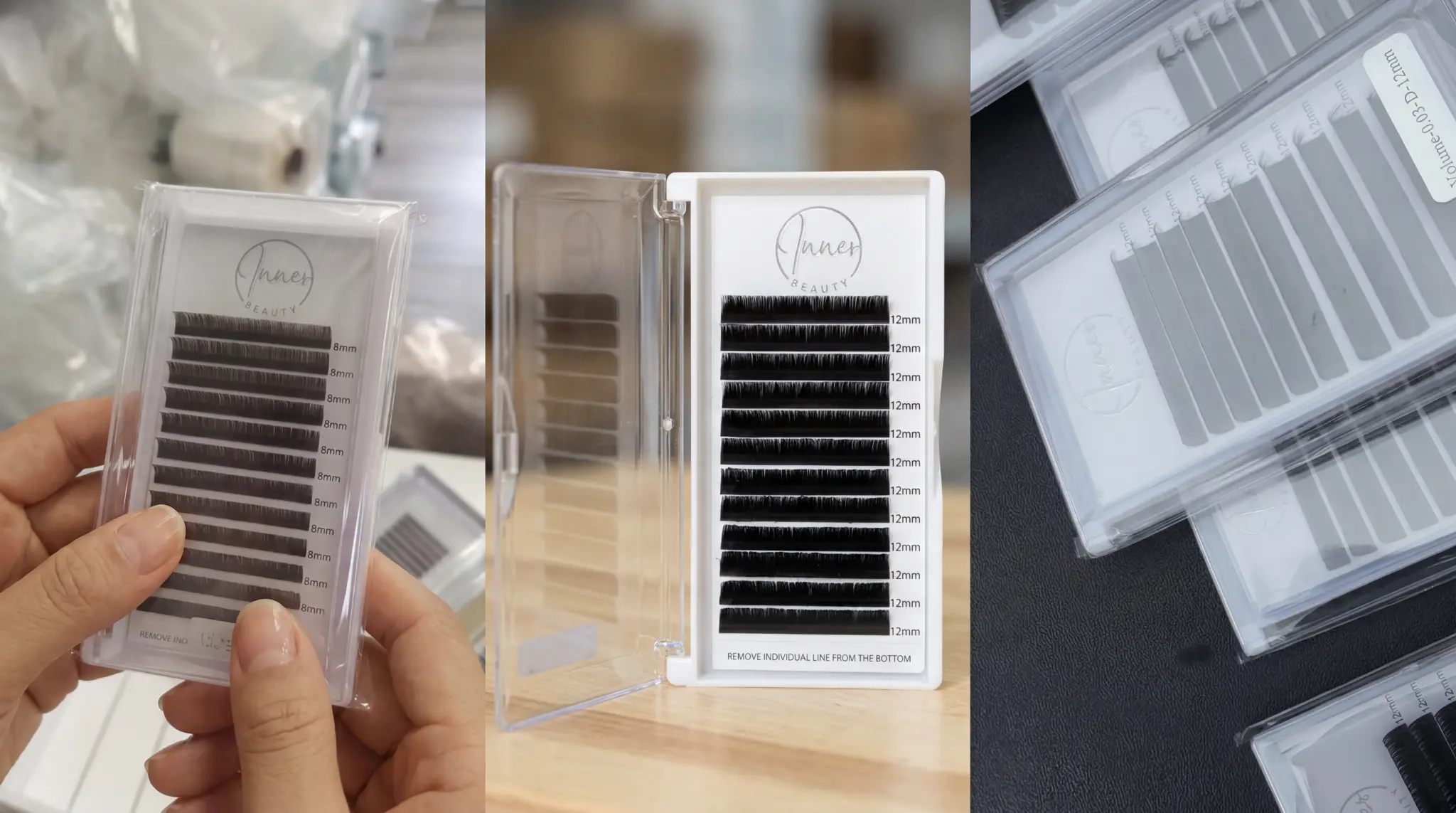
Both C and D curl are available across our full range:
- Classic: C and D in 0.07, 0.15, and 0.20mm diameters, lengths 7–16mm
- Volume: C and D in 0.03 and 0.05mm diameters, lengths 7–16mm, Black and Brown
Every combination is $8/tray with Pro Access ($12 retail). No minimums — order one tray of each to test before committing to a full restock.
Browse the full catalog to see every curl, diameter, and length combination available.